


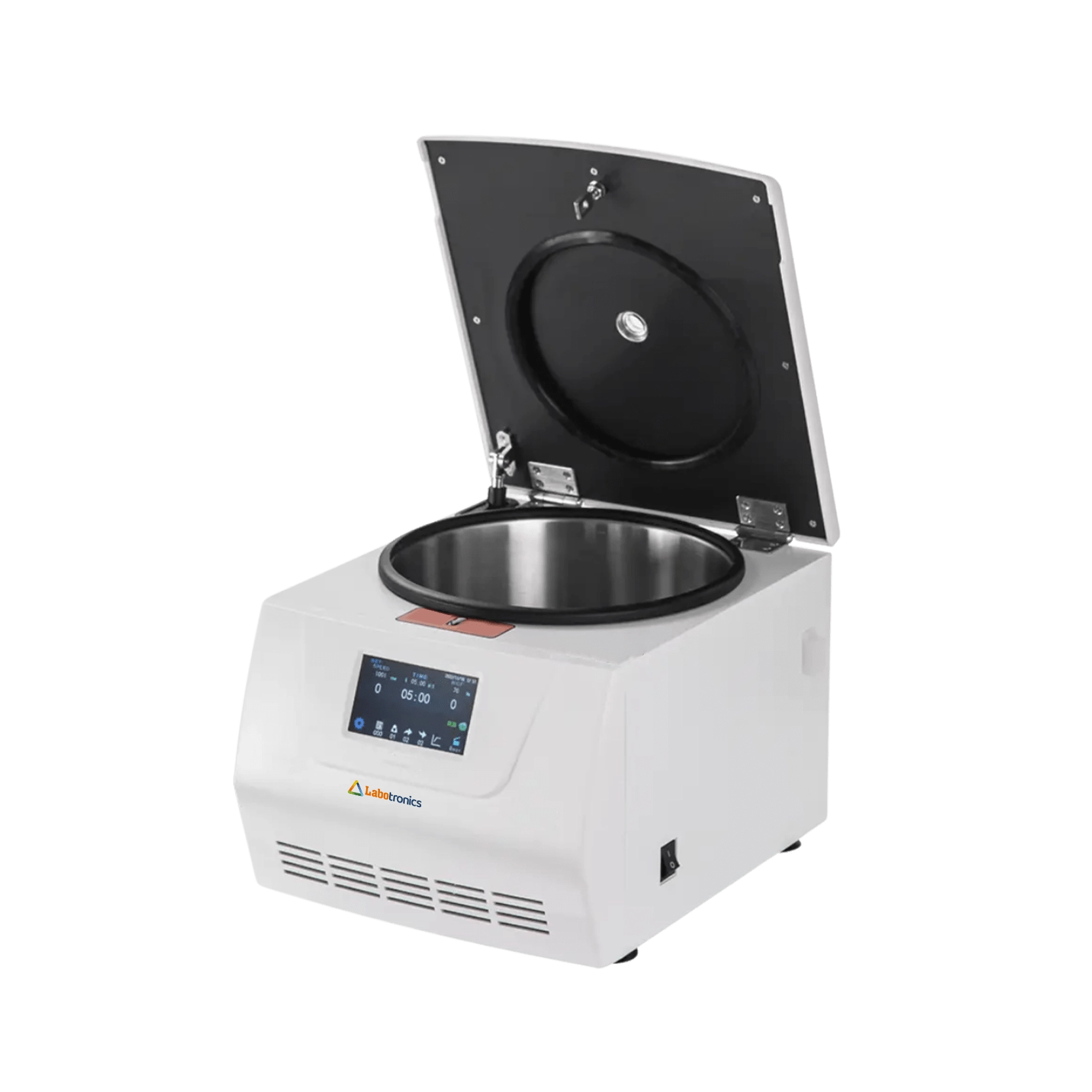

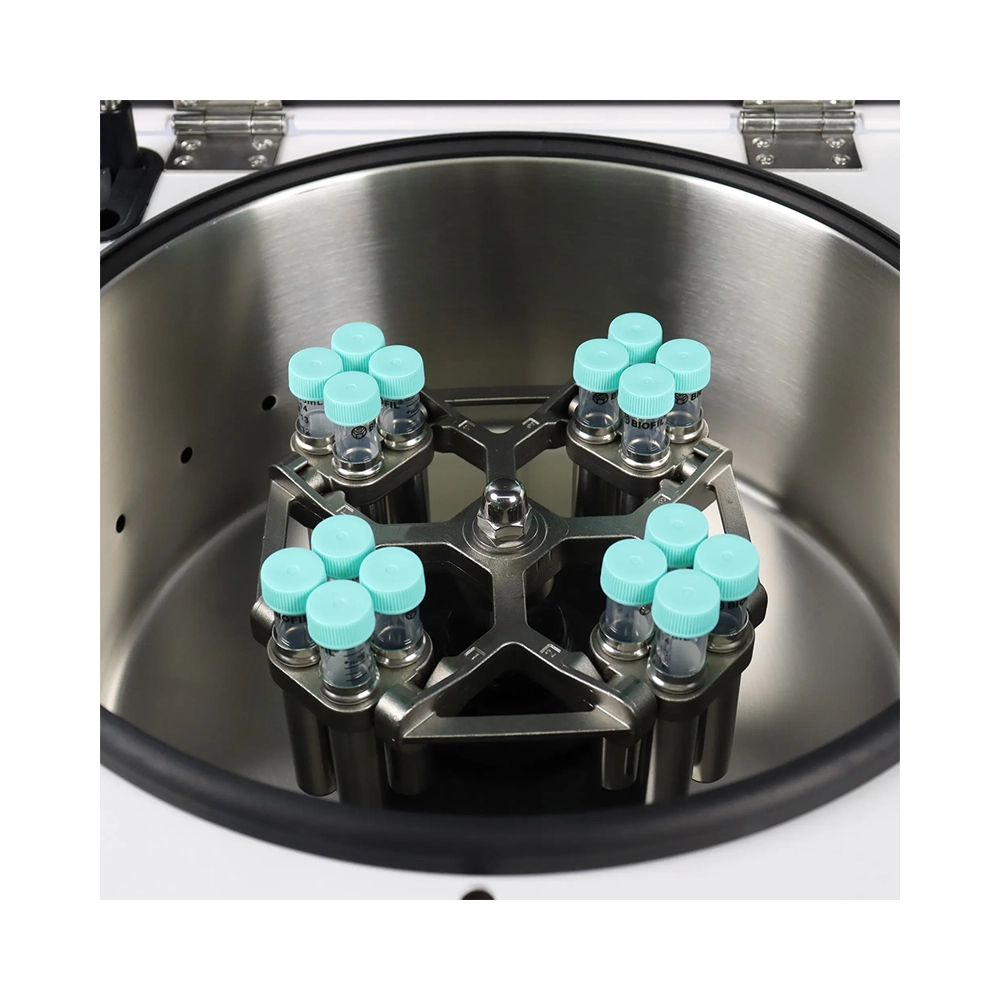
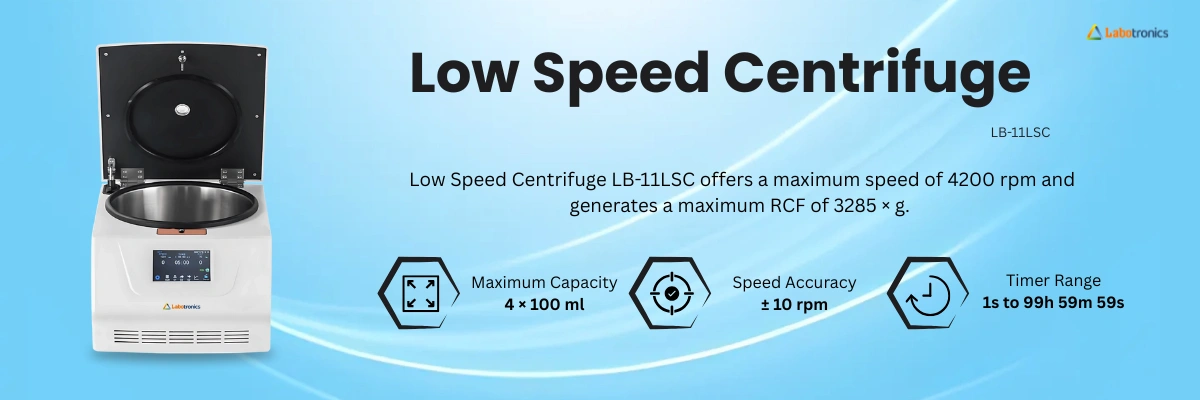
Low Speed Centrifuge LB-11LSC offers a maximum speed of 4200 rpm and generates a maximum RCF of 3285 × g. It offers up to 40 acceleration and deceleration rates, allowing smooth and controlled speed transitions. It has a motorized electronic door lock, preventing accidental exposure and enhancing user safety. Our low-speed centrifuge features an LCD touch screen, enabling real-time data monitoring and control.
Get Quote Download CatalogSpecifications
| Maximum Speed | 4200 rpm |
| Maximum RCF | 3285 × g |
| Maximum Capacity | 4 × 100 ml |
| Speed Accuracy | ± 10 rpm |
| Timer Range | 1s to 99h 59m 59s |
| Display | LCD |
| Noise Level | ≤ 60 dB(A) |
| Power Consumption | 500W |
| Dimension | 495 × 400 × 420 mm |
| Net Weight | 27 kg |
Features
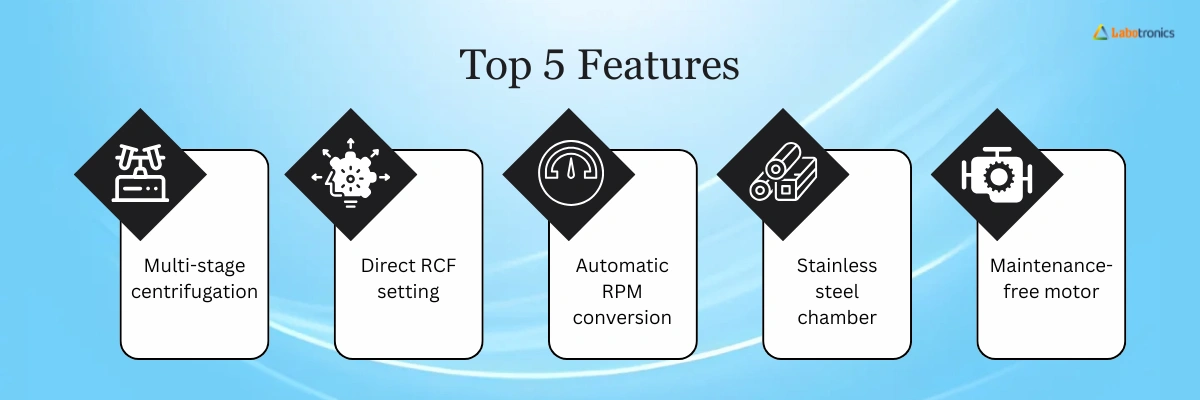
Multi-stage centrifugation
Direct RCF setting
Automatic RPM conversion
Stainless steel chamber
Maintenance-free motor
Autoclavable rotors
Applications
Low Speed Centrifuge LB-11LSC is ideal for sample separation, sedimentation, and blood component processing. It is widely used in clinical laboratories, hospitals, research institutes, and educational settings.
Rotor Selections
Rotor Type | Capacity | Maximum Speed | Maximum RCF |
Swing-out Rotor 1 | 4 × 50 ml | 4200 rpm | 3281 × g |
Swing-out Rotor 2 | 4 × 100 ml | 4200 rpm | 3281 × g |
Swing-out Rotor 3 | 16 × 15 ml | 4200 rpm | 3259 × g |
Swing-out Rotor 4 | 8 × 50 ml | 4200 rpm | 3285 × g |
Frequently asked questions For
1. What are low-speed centrifuges, and what are they used for?
Low-speed centrifuges are laboratory devices used to separate biological samples like blood, cells, or fluids at gentle rotational speeds. They are ideal for preserving the integrity of sensitive samples during processing.
2. What are the key features of the Labotronics low-speed centrifuges?
The key features of the Labotronics low-speed centrifuges are their smooth operation, with fixed-angle rotors that handle various tube types efficiently for precise separation.
3. Where are low-speed centrifuges suitable?
Low-speed centrifuges are suitable for clinical labs, research facilities, medical centers, academic institutions, and biotech labs, where gentle sample separation is crucial.
4. What kind of outputs can I expect from using low-speed centrifuges?
By using low-speed centrifuges, you can expect to achieve clear, separated layers of biological material, enhanced lab efficiency, and consistent results in sample preparation.
Still have questions?
If you cannot find answer to your question in our FAQ, you can always
contact us. We will answer shortly!

| Maximum Speed | 6000 rpm |
| Maximum RCF | 5200 × g |
| Maximum Capacity | 4 × 500 ml |
| Speed Accuracy | ± 10 rpm |

| Maximum Speed | 6000 rpm |
| Maximum RCF | 5123 × g |
| Maximum Capacity | 6 × 50 ml |
| Speed Accuracy | ± 10 rpm |
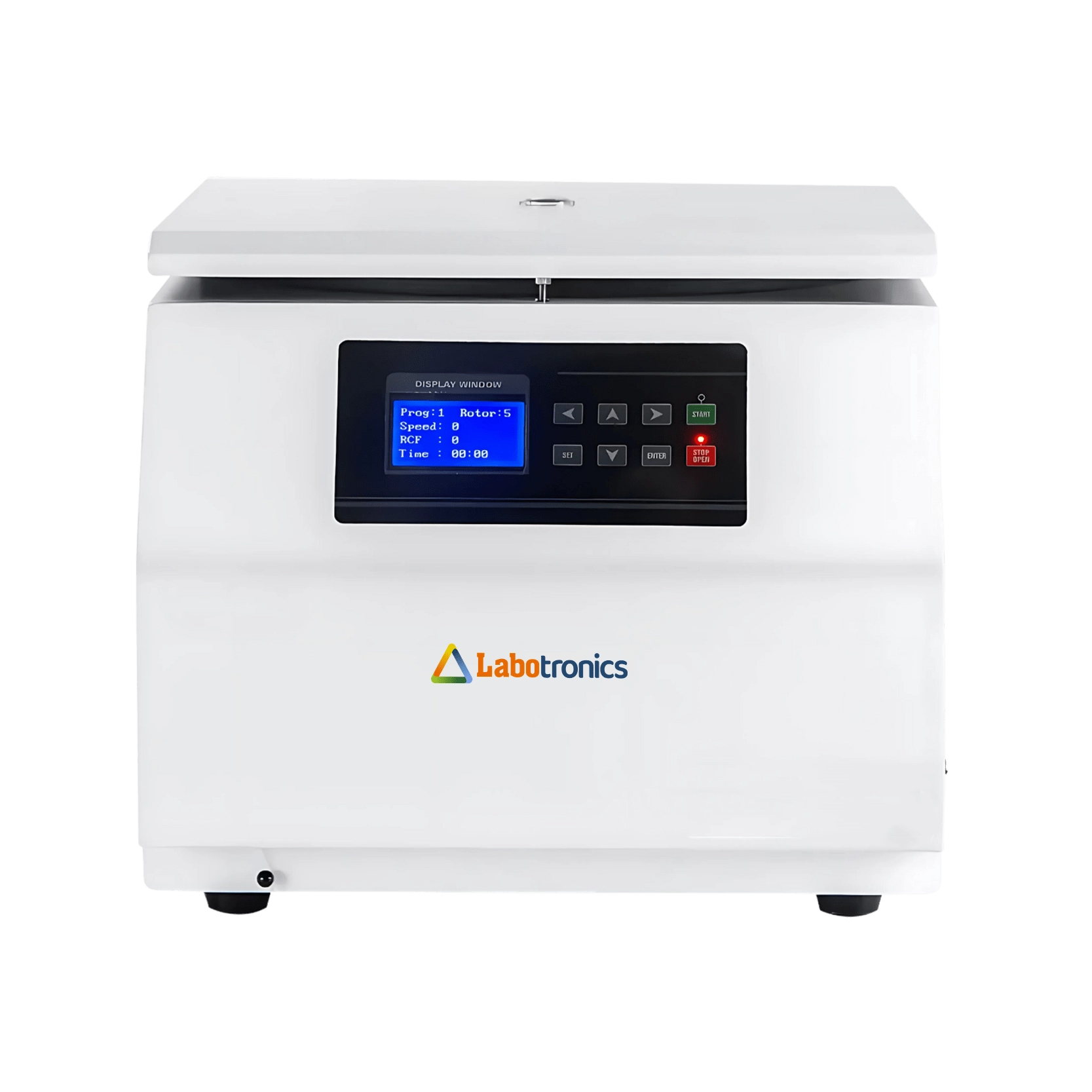
| Maximum Speed | 5000 rpm |
| Maximum RCF | 5200 × g |
| Maximum Capacity | 4 × 500 ml |
| Speed Accuracy | ± 10 rpm |
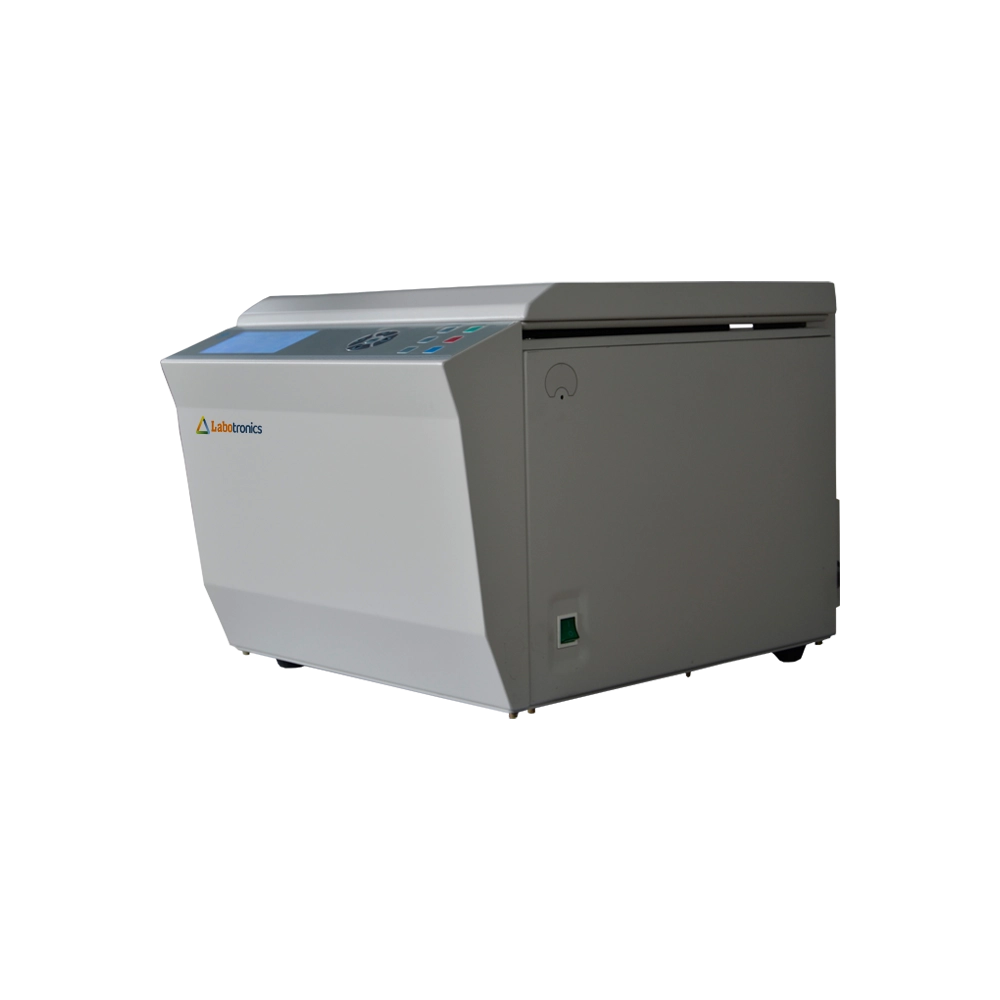
| Max capacity | 4×100 ml |
| Max speed | 6000 rpm |
| Max RCF | 5000×g |
| Speed accuracy | ±20 rpm |
| Max speed | 6000 rpm |
| Max RCF | 5000 x g |
| Rotor capacity | 4 x 450 ml |
| Temperature raise | ≤ 10 °C |

| Maximum Speed | 5000 rpm |
| Maximum RCF | 4650 × g |
| Maximum Capacity | 8 × 100ml |
| Speed Accuracy | ± 10 rpm |
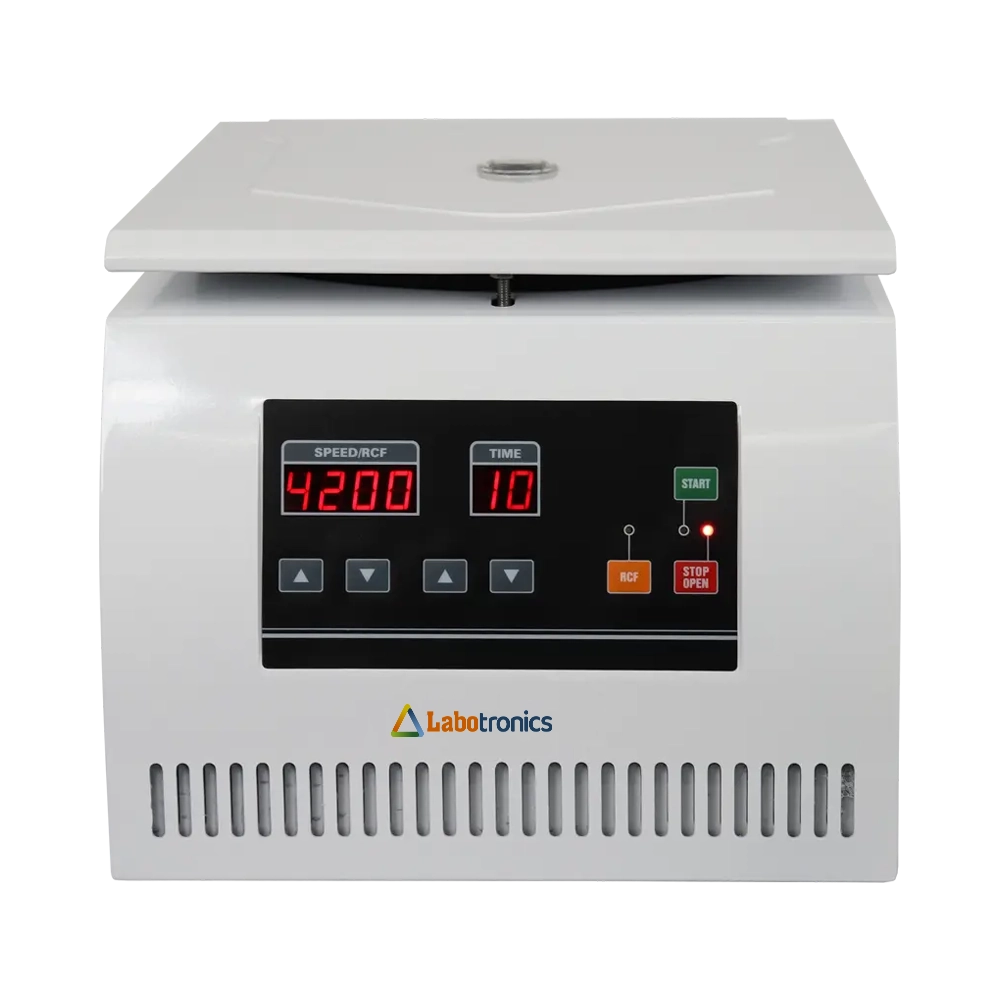
| Maximum Speed | 4200 rpm |
| Maximum RCF | 2680 × g |
| Maximum Capacity | 24 × 10 ml |
| Speed Accuracy | ± 20 rpm |

| Maximum Speed | 5000 rpm |
| Maximum RCF | 4650 × g |
| Maximum Capacity | 6 × 50 ml |
| Speed Accuracy | ± 10 rpm |

| Max speed | 6000 rpm |
| Max RCF | 5000 x g |
| Rotor capacity | 15 ml / 20 ml x 6 |
| Temperature raise | ≤ 10 °C |
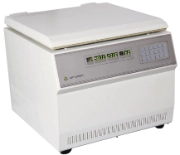
| Max speed | 6000 rpm |
| Max RCF | 5000 x g |
| Rotor capacity | 4 x 300 ml |
| Temperature raise | ≤ 10 °C |

| Maximum Speed | 6000 rpm |
| Maximum RCF | 5201 × g |
| Maximum Capacity | 4 × 800 mL |
| Speed Accuracy | ± 10 rpm |

| Max speed | 6000 rpm |
| Max RCF | 5000 x g |
| Rotor capacity | 8 x 100 ml |
| Temperature raise | ≤ 10 °C |

| Max speed | 6000 rpm |
| Max RCF | 4830 x g |
| Rotor capacity | 12 x 15 / 20 ml |
| Temperature raise | ≤ 10 °C |
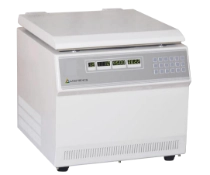
| Max speed | 6000 rpm |
| Max RCF | 5000 x g |
| Rotor capacity | 15 ml /20 ml x 6 |
| Temperature raise | ≤ 10 °C |
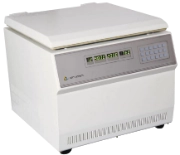
| Max speed | 6000 rpm |
| Max RCF | 5000 x g |
| Rotor capacity | 4 x 250 ml |
| Temperature raise | ≤ 10 °C |

Address: Labotronics Scientific. 1007 N Orange St.,
Wilmington, DE 19801, USA
Mail: info@labotronics.eu
WhatsApp: +1 579 401 0534
All Sections
Best Seller
Quick Links
Copyright © Labotronics Scientific 2026