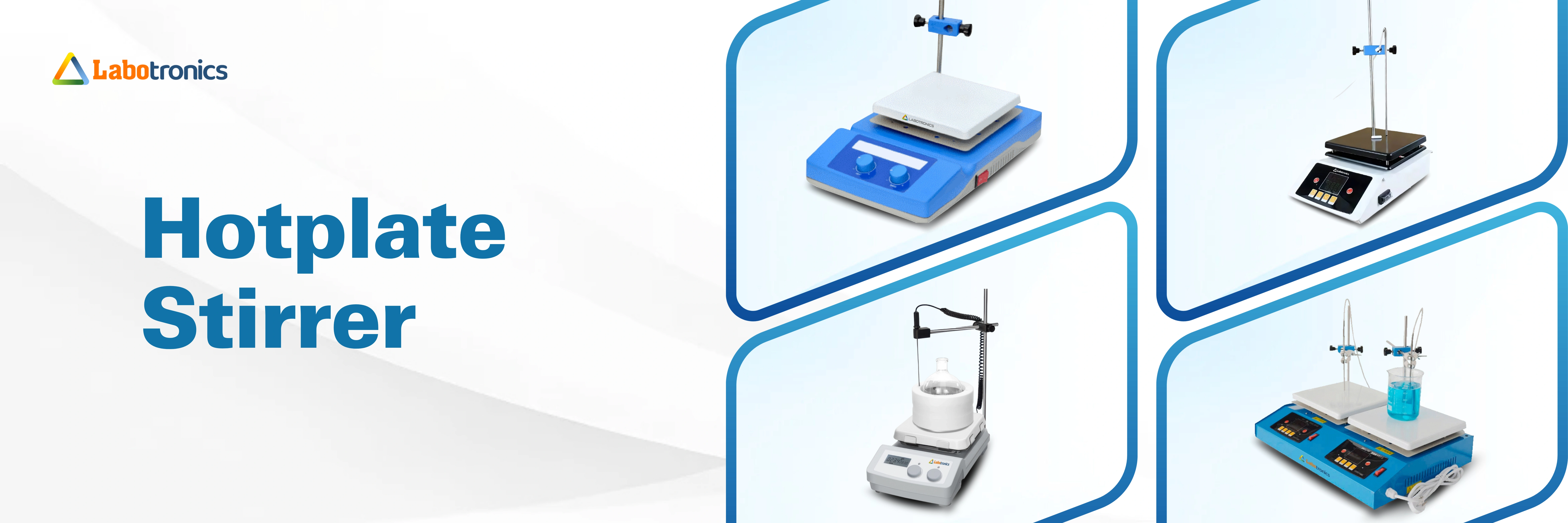
Overview
Hotplate stirrers,
commonly known as magnetic stirrer hot plates, lab hot plates, or scientific
hot plate magnetic hot plates, are vital laboratory equipment used to help heat
and mix in scientific, industrial, and educational settings. This small
equipment consists of a heating plate containing a magnetic stirrer, which
enables individuals to uniformly mix solutions and control temperature at the
same time. With uniform mixing and heating, hotplate stirrers help chemists,
scientists, and other laboratory professionals perform experiments with more
reliability and reproducibility.
Hotplate chemistry
platforms or hot plate laboratory activities, regardless of chemical reactions,
sample preparation, or microbiology, improve convenience, precision, and
safety. It is important to understand hotplate stirrers and their operation
before purchasing. Areas of important consideration include how hotplate
stirrers work, where hot plate stirrers might be beneficial, and hot plate stirrers'
features relative to your laboratory's required needs.
What Is a Hotplate Stirrer, and Why Do We Use
It?
A hotplate stirrer, also
referred to as a hot plate with digital contact temperature, combines the two
essential lab functions of heating liquids and stirring solutions. A small
magnetic stir bar is placed in the liquid and is rotated inside the liquid by a
rotating magnetic field located beneath the plate. The stirring or mixing is
accomplished without any physical intervention by the lab technician, which
ensures uniform mixing will occur. These pieces of laboratory equipment are
used in labs and university teaching because they permit researchers to
efficiently dissolve solutes while holding reactions at a very precise
temperature, perform titrations consistently, and prepare solutions, reducing
human error and labor in physical replacements.
How Do Hotplate Stirrers Work?
Hotplate stirrers are
based on a straightforward but efficient concept. Their operation involves two
primary systems: a heating system and a stirring system. The heating system
consists of a flat plate, usually ceramic or aluminum, which heats as current
flows through an internal resistance coil. Heat is evenly transferred to the
vessel atop the plate. The stirring system employs an internal motor or
electromagnet to create a rotating magnetic field that turns a magnetic stir
bar inside the solution, continuously and evenly mixing.
Modern hotplate magnetic
stirrers often have digital temperature and speed capabilities for precise
settings, over-temperature protection to avoid overheating, and programmable
features to automate the heating and stirring processes, allowing for
convenience and safety in the laboratory.
Key Features to Look for in a Hotplate
Stirrer
· Temperature
Range & Accuracy – The maximum heating temperature
typically ranges up to 380–550°C. Digital models are accurate to ±1°C.
· Stirring
Speed Range – A stirring speed range from 100 to 2000
rpm allows gentle mixing or vigorous agitation.
· Plate
Material – Ceramic plates are resistant to chemical corrosion;
aluminum plates heat quickly and are more durable.
· Capacity
& Load Bearing – Be sure to select an appropriate
hotplate stirrer for your solution volume and vessel weight.
· Safety
Features – Auto shut-off, temperature limiters, and anti-slip
platforms all help to ensure safe operation.
· Digital
vs. Analog Controls – Select an analog hot plate for routine
usage or a laboratory hot plate with a digital temperature control for careful
experiments.
Where Are Hotplate Stirrers Commonly Used?
· Chemical
& Pharmaceutical Laboratories – Mix reagents, dissolve
solids, and run permissible reactions.
· Biological
& Microbiological Studies – Culturing media
preparation, enzyme reactions, and cell culture experiments.
· Educational
Institutions – University and schools for the teaching
of basic laboratory techniques.
· Food
& Beverage Testing – Sample preparation and quality
control processes.
· Industrial
Research – Product development, material testing, and R&D
labs requiring precise heating and mixing.
Conclusion
Choosing the best hotplate stirrer or magnetic stirrer hot plate will depend on your laboratory’s needs, workload, and accuracy requirements. Labotronics offers a complete range of hotplate stirrers that include the (analog) line LB-10HPS to LB-13HPS with 1L to 15L capacity in ceramic plates, with a maximum temperature of 400°C; the intelligent hotplate stirrers LB-20HPS to LB-23HPS with advanced digital controls for research-grade accuracy; and hotplate stirrers with a timer LB-30HPS to LB-34HPS with the ability to time heat and stir with maximum 20L capacity at 550 °C.
Additionally, you can find multi-point hotplate stirrers in models such as 5-point, 10-point, 2-position, 3-position, 4-position, and 6-position, with each heating element capable of accommodating a range from 50 ml to 15 L. Offering a rugged design with efficient heating and a range of heating capacities, these laboratory hot plates featuring digital temperature control are reliable tools in chemistry, biology, pharmaceuticals, chemical process, and TLC laboratory research production applications. From compact analog stirrers to advanced intelligent multi-position edible laboratory hotplate stirrers, Labotronics hotplate stirrers can improve lab workflow efficiency and save time and space by finding the right model that best suits the laboratory's needs.
Explore the complete
Labotronics hotplate stirrer series to find the model that best matches your
laboratory’s requirements. Please click here.
Contact Us: +1-202-555-0191

Address: Labotronics Scientific. 1007 N Orange St.,
Wilmington, DE 19801, USA
Mail: info@labotronics.eu
WhatsApp: +1 579 401 0534
All Sections
Best Seller
Quick Links
Copyright © Labotronics Scientific 2026